Sunday, 11 January 2015

Birdman (or The Unexpected Virtue Of Ignorance)


Birdman is a black comedy of sorts about a man called Riggan Thomson (Michael Keaton), a man typecast as Birdman, a superhero type character who pulled in the punters at the multiplexes and presumably ran for several pointless (you would imagine) sequels. Thomson, now ashamed of this 'selling out', wants to reinvent himself as a ‘proper’ actor on Broadway. Keaton, twice Batman of course before quitting to avoid becoming typecast himself, appropriately plays the lead.


In an attempt to prove himself, Thomson directs and stars in his own adaptation of a Raymond Carver short story. It is a bold attempt to be taken seriously but also a doomed one. Throughout he is persecuted by the character that made him famous. His Birdman alter ego keeps appearing in his mind, telling him that he will fail.


The public too do not want him to move on from Birdman and the critics, namely Tabitha of the Times (Lindsey Duncan), will never give him a good review because of who he is.


Then when his co-lead in the play is mysteriously knocked unconscious by a falling stage light, it is thought that his replacement well known method actor, Mike Shiner (Edward Norton), could well save the show. Mike though is exceptionally unstable. He gets drunk during his first rehearsal and later attempts to have sex with the female lead (Naomi Watts) whilst they're on stage.

He fails on that score but is more successful with Thomson’s daughter (Emma Stone), an assistant on the production and straight out of drug rehab.


Thomson’s quest is further derailed by his girlfriend (Andrea Riseborough), who might or not be pregnant, his ex-wife (Amy Ryan) who can't seem to stay away from him and his pushy producer (Zach Galifanakis).

Everyone is depicted as deeply flawed as the film takes a dig at actors in general as well as taking shots at a public that will shell out good money to see action packed rubbish.


Birdman is good but not fantastic and it isn't ground breaking by any means but in what looks like being a meagre year for award contenders it may be one of the best we get.

Sunday, 4 January 2015

The Theory Of Everything


The film is a biopic of Stephen Hawking (Eddie Redmayne) but one that is focussed only on the time span of his relationship with Jane Wilde (Felicity Jones) who was to become his wife. It is from Jane’s book that the screenplay is taken. 

They meet almost as soon as the opening credits are off the screen. He’s a nerdish doctoral student in 1960’s Cambridge, she is a fellow student preparing for a PhD who finds him interesting and you assume attractive. She loves poetry, romance and God while he believes in logic, reason and not a lot else. Opposites attract I guess. They date and flirt, very badly, but sort of get together despite everything and particularly despite the difference of opinion about God.


Then one day, already not too steady on his feet, Hawking falls badly and this leads to his diagnosis with motor neurone disease. They give him two years to live although obviously he’s still with us. 


We watch as his illness progresses and it gradually becomes harder for him to move, speak and do everyday things. Eventually he is confined to a wheelchair and has to speak through a computer.


Jane pledges to stick with him, they marry and she goes on to devote a huge chunk of her life to looking after him. Thirty years in fact until they divorce in 1995. She also has to look after their three children and still has time to complete her PhD. Yes three children, so something clearly still worked but the film doesn't go there. In fact it's a film that doesn't go to a lot of places and leaves a lot of unanswered questions.

Caring for her crippled husband visibly takes its toll on Jane but even when she meets Jonathan (Charlie Cox) she stays loyal to be husband and her relationship with Jonathan appears to remain platonic for some time as he helps her out with caring for her husband and children.

As the film goes on it, it becomes more and more of a biopic about her and less about him. In fact the film rarer mentions his career or theories and we never see him working.


Eventually he either releases her from the relationship or he dumps her for his nurse, I’m still not quite sure which.

I found it more interesting and informative than compelling but it's certainly a decent enough film. If a touch undramatic and sadly lacking in inner torment as they both seem to take his worsening condition rather well.

It’s a film that will surely be remembered most for the lead performances. Redmayne totally nails the physical side of Hawking and is completely convincing but kudos too to Felicity Jones, who in many ways is just as impressive.

Sunday, 7 December 2014

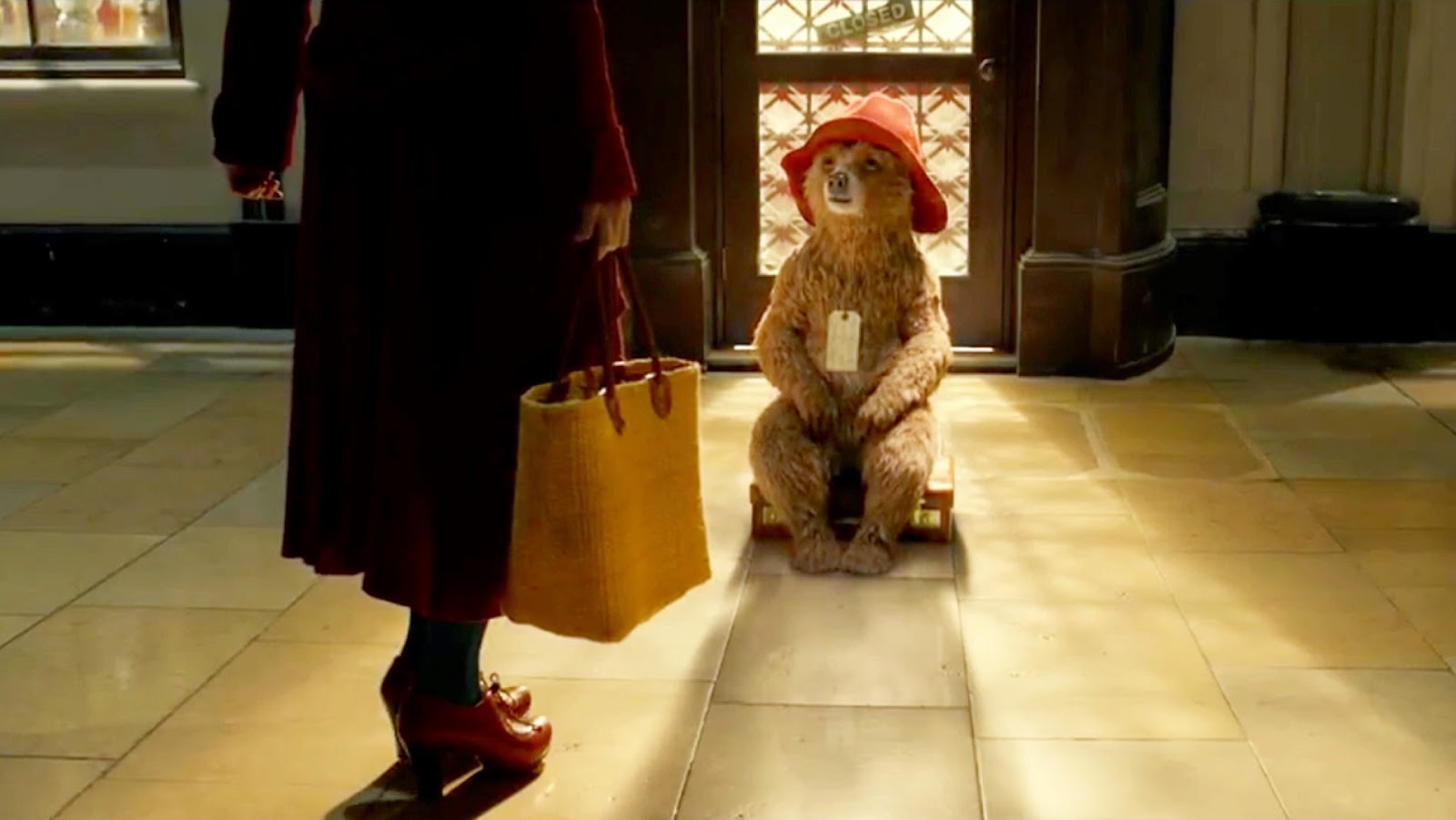
Paddington

Paddington was a huge part of my childhood. I had just always hoped that no one was going to mess with him and turn him into a film star or anything. Suppose you can’t have everything. At least he’s no longer going to have Colin Firth’s voice, which really would have been too much.


Initially the plot is good, they haven’t strayed from the whole family finding a talking teddy bear in a train station idea which is good and they’ve added a clever back story in Darkest Peru as well. As a Paddington aficionado I didn’t expect to like that but I did.

When an earthquake destroys their idyllic life in Darkest Peru, Paddington (Ben Whishaw) stows away on a boat bound for London whilst his Aunt Lucy (Imelda Staunton) heads for the notorious Home for Retired Bears.

Then he is rescued from Paddington railway station by the Browns (Sally Hawkins and Hugh Bonneville) and moves in at 32 Windows Gardens, where Mrs Bird (Julie Walters) is the housekeeper and next door is the legendary Mr Curry (Peter Capaldi). So far so good. He is introduced to Mr Gruber (Jim Broadbent) at his antique shop on the Portobello Road, presumably they have elevenses, and his first attempt at having a bath is predictably a disaster. 


Which is where things start to go a bit awry. Paddington seems to have an out of body experience as he virtually destroys the Brown's home. They may not have messed so much with Paddington himself but maybe they have with his mind.


Paddington himself is excellent. His expressions and mannerisms are spot on, an unfailingly polite bear at heart, although only one hard stare all film is a bit unrealistic. 


Then there’s all this palaver with Millicent the taxidermist (Nicole Kidman) who is determined to stuff the bear and put him in a glass box at the Natural History Museum. What’s that all about and why? Pointless and unnecessary. For some reason there is always an urge to turn every film into an action movie. Kidman herself seems to have misread the script as she looks and behaves more like a dominatrix than a taxidermist and I haven’t even mentioned Hugh Bonneville’s cross dressing. Then again, what’s Christmas without a touch of pantomime?


Still, it’s an excellent effort in bringing Paddington into the 21st century, whether he wanted to be in the 21st century or not and there are many references to Michael Bond's books for those who are paying attention.

Saturday, 4 October 2014

Before I Go To Sleep


Christine Lucas (Nicole Kidman) not only wakes up every day with no memory of the events of the previous day but she also wakes up alongside Colin Firth. Yes the girl has problems. Just when she’d thought she’s got over the Railway Man, here he is again.


Every morning she looks across at Firth, looks confused and maybe a bit pissed off before heading off to the bathroom where she is confronted with a wall of photographs. These are of herself and of herself with Ben (Firth) including several of their wedding.


Back in the bedroom, Ben confirms the whole horrible truth. Yes, she is married to Firth, again, and what’s worse is she can’t even remember doing it.

Well actually it’s worse than that, she has no recollection of the last twenty years. Which might appeal to some people but does seem a bit inconvenient.

Ben goes on to explain that she’d had an accident and can now no longer retain memories, then he buggers off to work and her doctor (Mark Strong) rings her. He tells her that she has been recording herself on a video camera to help remember things. Each day she’ll start to piece things together until it's time for bed again... and they’ll all be gone again.


Problem is he has to tell her where she’s hidden it. This incident, hiding the camera from her husband, sort of gives the plot twist away in the first ten minutes and undermines what is to come.


Her doctor gradually helps her unravel the mental mist and she also meets up with an old college friend Claire (Anne-Marie Duff) who disappeared from her life under somewhat dubious circumstances as the films builds to a somewhat grisly finale.


It's an odd but quite good film with a lot of ‘hang on but...’ moments. The overall premise is intriguing but ultimately once you’ve grasped that the film on the whole disappoints and peters out at the end. Kidman is again excellent though, Strong is good and Firth is, well, Firth. Probably a bit out of his comfort zone to be honest but he copes well enough.