Showing posts with label Stephen Graham. Show all posts

Saturday, 5 May 2018

Funny Cow

Funny Cow is about a stand-up comedienne (Maxine Peake) taking on the men at their own game in the dingy working men’s clubs of the 1970s. It is in one such place in the north of England where she sees the depressive Lenny (Alun Armstrong) up on stage, going through the motions with his dire material, and effectively dying, that inspires her in the first place. 


When she talks to him about his act, he assures her that ‘women aren’t funny’, and suggests she tries singing or stripping instead but it is comedy that she wants to do. Comedy is a release for her from her miserable life. 


From a childhood living with an abusive father (Stephen Graham) through to a dysfunctional marriage to the violent and controlling Bob (Tony Pitts) via a mother (Lindsey Coulson) driven to drink by life.


Finally leaving her husband and taking up with bookshop owner Angus (Paddy Considine), who takes her to see foreign films which fall way outside her comfort zone, turns out to be not that much of a trade up.

Meanwhile she struggles to gain a foothold in the world of the gungy pub carpet. She suffers from terrible nerves when she attends an audition where she is up against a singer (Richard Hawley), a ventriloquist (Vic Reeves) and an Elvis impersonator (John Bishop) with his dog (Bilko).


Eventually she blags her way on to stage when the promoter has little choice when faced with an empty stage. There she finally gains acceptance, and later success, but only by winning round the hostile audience by embracing the 1970's reality of doing racist and homophobic gags, while dealing with the inevitable hecklers.
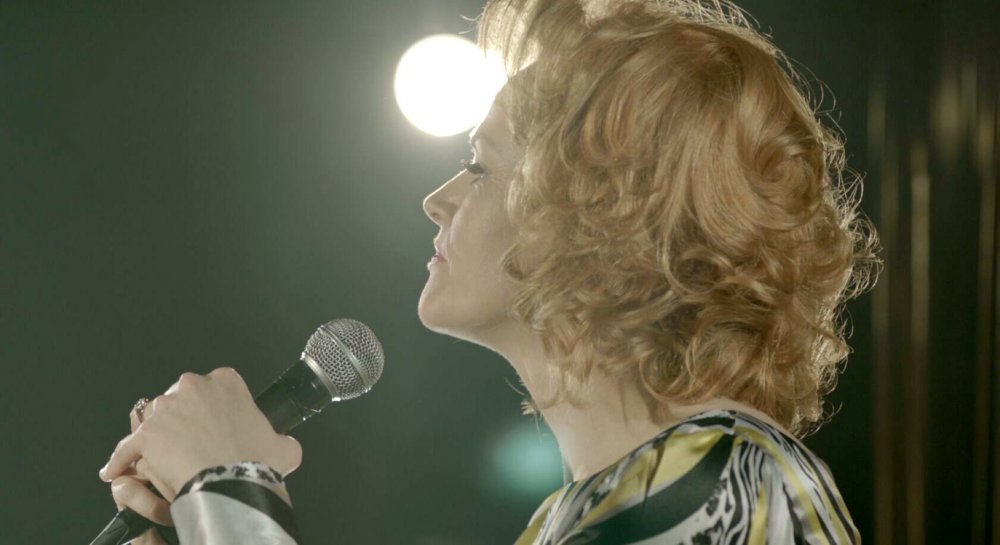

In the film we see her after her success, then before, then after again in series of Dave Allen like scenes in front of the camera. Scenes that for me distract from the narrative of the film and therefore drag down what was a generally strong film. 

The later scenes seem to show her just as cynical and disillusioned with everything as she was before she became a comedienne. Even being a success doesn’t appear to have brought her any happiness but then she probably never expected it to.

Sunday, 19 November 2017

Film Stars Don't Die in Liverpool

This is the story of the final days of Hollywood actress Gloria Grahame (Annette Bening) and also her relationship with Peter Turner (Jamie Bell), a young Liverpudlian actor half her age whom she met in the late 1970’s when they, incredibly, shared the same north London boarding house.


By this point, Oscar winner Grahame’s time in the limelight had seriously faded but she continued to work where she could and spent a lot of time performing on the stage in the UK. Turner and the hugely insecure Grahame, keen herself to feel young again, quickly became lovers. For a while at least, then she seemed to forget about him.


Until 1981 that is when, already ill, she collapsed one night and called him of the blue. She asked if she could stay over with him and his family in Liverpool. Where she hoped to spend time recuperating but, as it turns out, these were to be her final days.


Despite being exasperated that she won’t seek treatment, Turner along with his mother (Julie Walters) and father (Kenneth Cranham), looks after her. The film details his memories as he looks back on their brief transatlantic romance.


It does rather morosely becomes one long death scene but it is rather refreshing that her final decline happens outside of the public glare. This was a time when famous people could blend into every day life and not be recognised. It was a time before not only YouTube but before even DVDs. In fact VHS had only just been invented.

When the landlord of Turner's local pub does recognise his superstar girlfriend, it is a one off and nobody alerts the world via the yet to be invented Twitter. 


Finally her son, having been told about her illness, travels over to take her back home where she dies just a few hours after arriving in America aged just 57.

It's an excellent film for many reasons. Its story, its message, its time, its acting. Bening is brilliant and ably supported by Bell, with whom she shows great chemistry. There is also strong performances from his Cranham, Walters and Stephen Graham as Turner's brother.