Showing posts with label Carey Mulligan. Show all posts

Saturday, 25 January 2014

Inside Llewyn Davis


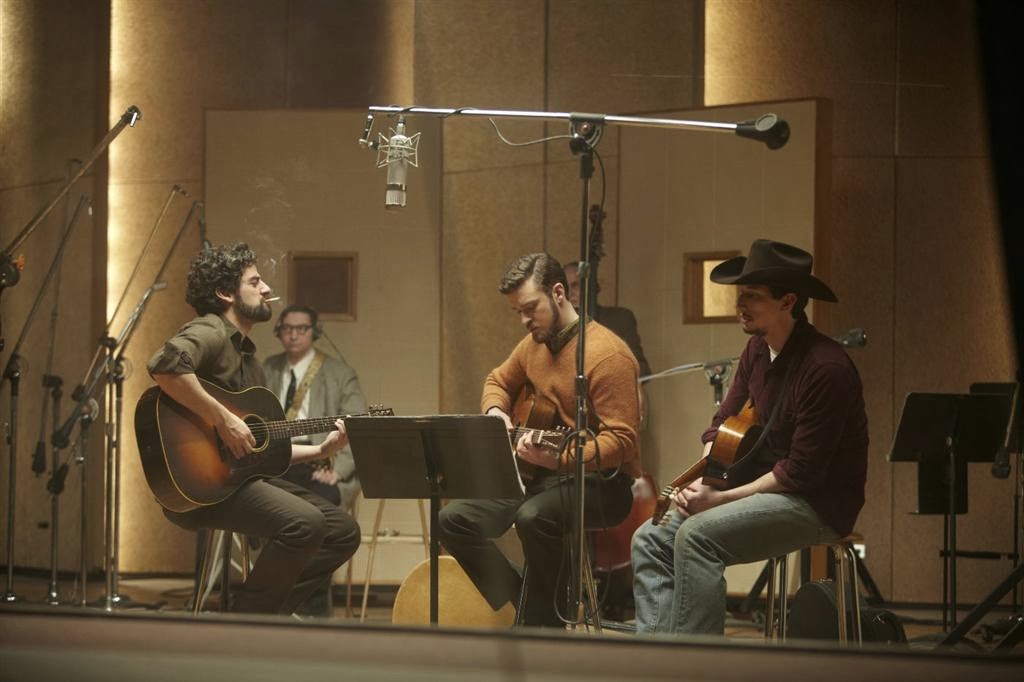
Set in 1960s Manhattan, Inside Llewyn Davis is a week in the life of a struggling folk musician. It's Reality TV done Coen Brothers' style, only the Coens aren't going to get the character to play up for the cameras now are they? This is warts and all, well just warts actually.

We meet Llewyn Davis (Oscar Isaac) singing on onstage at the Gaslight, then we see him get beaten up in the alley behind it. At the end of the film we find out why and in between we find out about the man himself.


There’s a lot to find out but not a lot to like. He’s penniless, homeless and largely clueless, singing his heart out about ‘life’ whilst drifting through his own. He lives from day to day, gig to gig, couch to couch unable to take care of himself, his friends, his family, his lovers, ex-lovers or for that matter even a neighbour’s cat.
 
We don’t particularly like him, he doesn’t particularly like himself and his ‘friends’ such as fellow singers Jim (Justin Timberlake) and Jean (Carey Mulligan) view him mainly with disgust and loathing.


He is a man capable of performing passionately behind a microphone but not in real life. Perhaps at one point Jean thought he could, as she's possibly carrying his child, but she was wrong and now she wishes to dispose of it.


When Jean and Jim attempt to take their music mainstream and have a stab at stardom, Llewyn wants no part of it feeling his music should be good enough as it is. It is an attitude the viewer should applaud but you don’t because you really don’t like the man. Even when we find out about the unexpected loss of his former singing partner, who killed himself, we don't feel any sympathy for him. 


Normally in films like this the lead character would have got a lucky break or suddenly got over himself, found a nice girl and discovered a personality but this is the Coens... So that isn’t going to happen. He is what he is. A man stuck in his own insular world where his own actions continually cause him to go nowhere.

In the end you want him to get punched in the face again because you have had more than enough of Llewyn Davis. If that is the case then you’ll like the ending.


Clearly we’re not supposed to like Llewyn Davis the man but as for the film... well it’s an interesting idea to make a film about an unlikeable character going nowhere but possibly not a great one. Still, I quite liked it.

Saturday, 14 January 2012

Shame

In Shame, on the surface Brandon (Michael Fassbender) seems to be your typical office worker and typical red-blooded male, checking out the girls from behind, eyeing them up on the tube and if he can pull someone in the bar after work then he wouldn't turn down any action offered to him.


Only I hope she doesn’t want to talk afterwards. She’ll likely be ushered out of the door pretty quickly, that is if she got in the door in the first place and wasn’t just offered a quickie in the street.

The Buzzcocks would have said ‘he's an orgasm addict, he's always at it’. Nipping off to the toilets if he gets a spare minute in his work day, for a quick one to one with his right hand and then later, a night of virtual sex in front of his laptop.


Although he seems to have little problem picking up women, he prefers prostitutes. He finds it easier to relate to them, or with his right hand, than with a real person. No strings attached. No feelings, no emotions. We’re led to believe he’s a junkie feeding a drug habit.

He certainly struggles to relate to his younger sister Sissy (Carey Mulligan) who turns up unannounced in his shower one night. Sissy has her own problems, is incredibly needy but probably just requires a bit of attention and to spend some time with her brother. They are both a bit of a mess, in different ways.


Brandon resents having her crash at his place as it interferes with his routine and he grows increasingly frustrated with her invasive presence. He also isn't too thrilled when she mimics some of his own behaviour by hooking up with a married man (James Badge Dale) who also happens to be Brandon’s boss. More than anything it’s not terribly good form to shag your brother’s boss in your brother’s own bed.

When Brandon actually tries to enjoy a date with a colleague from the office, it’s an uncomfortable night. He is much happier when he drags her out of work the next day and takes her to a hotel for, yes a quickie, but he can’t go through with it with someone he actual knows and respects.


Meanwhile the secrecy around his habit is starting to unravel. His computer at work is taken away by the IT department, to have all the porn he’s downloaded on to it removed. Luckily they don’t seem to suspect him. Then Sissy stumbles across one of his virtual friends on his laptop. Slowly his world begins to spiral out of control as he is forced to hunt outside his normal boundaries to feed his addiction.


There really is not that much to the film story wise. It’s a portrait of a man struggling with his inner sexual demons and it leaves a lot unresolved. There are no reasons offered for his addiction or for what is behind the strained relationship with his sister.

There’s plenty of explicitness, which in a film about sex addiction is understandable. However there is also quite a bit of gratuitous nudity... unless the film is hinting at something deeper. Sissy certainly isn't shy about being naked around her brother. If that had happened in our household there would have been plenty of choice words said on both sides.

At least the nudity isn’t discriminatory. A Michael Fassbender full frontal is followed by Carey Mulligan full frontal but then there’s that scene of Fassbender urinating... Was that really necessary?


The film sort of hangs around a shocking scene that comes towards the end, which I won’t divulge but again we’re left wondering, does it change anything?

Right at the close, he sees a woman on the tube, the same woman he eyed up right at the start of the film. On that occasion, as he pretty much telegraphed his intentions to her, she was happy to give him the eye back, clearly interested. Then when she got up, we saw her wedding ring and her expression change to one of shame for flirting with him before she ran out on to the platform. Despite running after her, he lost her in the crowd, leaving him gutted he would have to go elsewhere for his next ‘hit’.

Now she has glammed up and appears to have had second thoughts about having second thoughts but is Brandon still tempted after all he’s been through?

We came out of the cinema and my first thoughts were ‘is that it?’ I was a little disappointed but then we talked about it constantly for the next 24 hours, still trying to decipher it. Which is always the sign of a good film.

Saturday, 24 December 2011

Drive

‘Drive’ is the story of a ‘driver’ (Ryan Gosling), a man who is never named. He works in a garage but moonlights as a stunt driver, a budding racing driver and as a getaway driver for the local criminals. That’s a lot of driving.


He’s a bit of a loner, who doesn’t go much for words or even facial expressions. Although he does break in to a smirk of sorts when he finds out he’s got Carey Mulligan (who plays Irene) living next door.


Then Mulligan is at it too, throwing in big deafening silences and long evocative looks, in her case trembly, dewy-eyed and innocent ones. The two of them say so much by not saying anything but it works. In this way she sort of hits on him and he gets involved in her life, befriending her young son Benicio along the way.

You can only assume she’s fallen for Gosling's tough but caring persona and his silent charm, it certainly wasn’t his chat up lines, the few words he does utter are around the toothpick that hangs permanently from his lips. I’m not sure where he put that when he snogged her in the lift, which was the films only departure into passion and that was only as a diversion so that he could kill someone. This is a romance that never goes anywhere but then Mulligan does still only look about fourteen, despite having a son.


Now I’ve gone and mentioned the killing. Gosling's character bursts into violent life mid-film, embracing violence on a sort of ‘Eastern Promises’ level. It kicks off when Irene’s husband Standard (Oscar Isaac), who was in jail, is released on parole and people are keen to settle scores with him. Standard thanks our driver for looking after his wife while he was inside, seemingly oblivious to the chemistry sizzling off the pair of them, even in his presence. The two of them get on and our man offers to do a driving job for Standard to pay off his pursuers but it all goes horribly wrong.


The violence then gets ratcheted up with the driver doing a hatchet job on all the mobsters who come to get him until it’s a case of last man standing. Some of the scenes are accompanied by the sort of gallows humour that is right out of the Tarantino scrapbook.


Overall it’s an absorbing piece of cinema. Some would call it slow but I’d call it tense and involving. The soundtrack is pulsating, the cinematography great and the dialogue lean, obviously. Even the car chases, of which there are plenty, don’t irritate like they normally would.

Acting wise, Gosling is great, the man gets more impressive with each film he does. Mulligan is good too and backed by a strong supporting cast of mobsters. One of the best films of 2011 or 2012 depending on when you see it.

Monday, 2 May 2011

Never Let Me Go

Tonight ,‘Never Let Me Go’, not the vampire one. It is based on a book by Kazuo Ishiguro, which I haven’t read. It’s a dark, depressing tale, which opens with a man in hospital on an operating table but soon we get flashbacks to the happier surroundings of a typically English boarding school. The period is the late 1970’s/early 1980’s and it is here at Hailsham that Ruth, Tommy, and Kathy H grow up together. They fall in and out with each other and do all the other things kids do.

Tommy is a bit of a misfit but Kathy is always keen to help him out and he becomes the not so secret love of her life. Their affection is mutual but ultimately he's stolen from her by the jealous and much more confident Ruth.

Boarding school is often a sheltered existence but this school is more sheltered than most, there are no parents in the background, no brothers and sisters at home. The children don’t question it, in fact they don’t question much and when a new teacher (Sally Hawkins) reveals the reason for their existence, and is fired the next day for doing so, they pass it off with a shrug. They had suspected something like that all along. They are human clones, born to exist solely to have their organs harvested once they reach adulthood.

This is an alternative Britain, where life expectancy has risen to over one hundred years because science has eliminated disease by taking organs from clones like them. The dating of this in the past rather than the future is interesting, does the author suspect this goes on now... and the period adds to the ‘1984’ touch the film already has.

When the three of them are old enough to leave ‘school’ they are moved into a farmhouse where clones from other institutions in the ‘National Donor Programme’ reside. The other institutions were more ruthless places. Hailsham was an experiment in treating the donors humanly; elsewhere the clones were treated more like livestock. Now though, for all of them, the clock is ticking. The farmhouses are simply waiting rooms until the day of their donations arrive. Meanwhile Tommy and Ruth are very much an item and consequently the relationship between the two girls gets more strained by the day.


Keira Knightley plays Ruth and I've always had a bit of a problem with Keira’s acting. She’s much the same in this. When the two leading ladies are required to do ‘sad’ Keira does it by quivering her bottom lip as if it's on a puppeteer’s string whereas Carey Mulligan, who plays Kathy, does it with every part of her face. Different class. Although the rivers of tears were perhaps a bit overdone by the special effects department.


Roll on a few years to 1996. Kathy is now a carer, the only recognised way to dodge the knife for a year or two. Carers help the others through the donation process until eventually they too have to face their own demise. She comes across Ruth, who she hasn’t seen for years, in one of the hospitals. Ruth has already made two donations. No one usually survives a third and they’ll be no Holby City style cardiac team rushing around trying to save a donor. They are simply said to have ‘completed’ and it’s Goodnight Vienna.

Ruth leads Kathy to Tommy (Andrew Garfield), who has also made multiple donations. At which point Ruth apologizes to them both for stealing Tommy. Just a touch bloody late love.


Although... had Tommy already donated his brain at that point, so that he was unable to choose between the two girls for himself? Ruth clearly thoughtlessly forced him to have night after night of raucous sex with her, against his will, and in Kathy’s face, when they all lived in the farmhouse together.

This does though tally with the theme of passive acceptance that runs throughout. There is no fight in any of them. Their situation is seemingly just one more thing to add to the long list of things a teenager can get pissed off about but CBA to find a solution to.


I guess, the point is supposed to be that they have been bred and raised to accept their fate, just like farm animals and farm animals don’t tend to plot revolution. People though are not farm animals and although she claims to regret it now, Ruth did at least have the balls to embark on a passionate affair during her short life. While the other two generally just wandered around looking lost. Kathy would probably never have gotten around to jumping Tommy even if they’d been given another 50 years to live. She only pairs up with him now, in 1996, because Ruth throws them together and equally it’s Ruth who persuades them to seek out their former guardians to find out if the rumour that people who are in love can be given a deferral, a few more years of life, is true. It isn’t. This though shows that there's perhaps a little fight in them somewhere.

Yet nobody, not even Ruth, rebelled in the face of the establishment. No one ever tried to run away. Would anyone have tried to stop them if they had? Who knows? They had wrist bands to clock in and out of the farmhouse but other than that... nothing, no watchtowers, no razor wire. What's the worst thing that could have happened to them? Death? ‘Never Let Me Go’ isn't a story that is big on answers.

Instead their fate is chillingly accepted and the utter passivity of the three of them is heartbreaking but also quite annoying.


So, no, the story does not have a happy ending. There is to be no final twist. In the concluding scene Kathy stares out across the fields, both her friends are now gone, her carer duties are completed and her first donation is scheduled. Although she can at least reflect on the fact that she did finally get to slip into bed with what was left of Tommy and thankfully found something that had yet to be donated.

In her life, as I guess in ours, there are no deferrals, no second chances. In the end we are all powerlessness to prevent death. It comes to everyone and always too soon, perhaps leaving us all thinking that we've not had enough time to do what we wanted to do.

This was a difficult film to make I would imagine and ‘Never Let Me Go’ is very good, to a point. It is dark, tragic and thought provoking, yet it's exasperating because it’s difficult to get attached to any of the characters or their unfulfilled love affairs and therefore the overall impact is perhaps not as great as it could have been. Still, I do love an unhappy ending.