Saturday, 11 January 2020

1917

It is 1917 in the British trenches and the German army appear to be in withdrawal but aerial reconnaissance has revealed that they are in fact lying in wait for a British attack. Two British soldiers, Tom Blake (Dean-Charles Chapman) and William Schofield (George MacKay) are called upon by General Erinmore (Colin Firth) to carry a message by hand, because field telephone lines have been cut, to Colonel Mackenzie (Benedict Cumberbatch) of the Devonshire Regiment. The message will instruct Mackenzie to call off the scheduled attack because it would jeopardise the lives of 1,600 men. Blake has been chosen because his brother Joseph (Richard Madden) is one of these men.


With time short, the men leave the trenches and cross No Man’s Land which is a sea of bodies, dismembered limbs and dead horses until they reach the abandoned German trenches, which they find are booby-trapped. A tripwire is triggered by a rat and the explosion nearly kills Schofield but Blake rescues him.


They then reach at an abandoned farmhouse from where they witness a German plane being shot down. They drag the injured pilot from the plane before it explores but the ungrateful pilot stabs Blake. Schofield shoots the pilot but can't save Blake and has to carry on alone.


After hitching a lift with another British convoy, Schofield then has to cross a bombed out canal bridge into the ruins of Écoust-Saint-Mein where he comes under fire from a German sniper. In the ensuing fight the sniper is killed and Schofield is knocked out cold. When he regains consciousness he heads off through the bombed-out French town under heavy fire.

It is rather unbelievable that he manages to dodge so many bullets before stumbling into a basement where he has time for a social call with a French woman (Claire Duburcq) and her child while I am literally screaming at him that he has a battalion to save.


Eventually continuing on, Schofield is again repeatedly shot out before escaping by jumping into a river where he amazingly avoids drowning despite being swept over a waterfall. Suddenly it's all gone a bit Indiana Jones.

The river spit him out on to a riverbank which by some amazing coincidence is where the Devonshire Regiment are having a singalong before heading to battle. Schofield manages to creep up on the Regiment without anyone noticing as they seem to have neglected to post any guards.


In one sense director Sam Mendes has made an epic film that looks great, is really dramatic and that puts the audience right in the middle of the action. It would also have been nail-biting stuff if you didn’t know for sure that Schofield would make it to Blake’s brother once Blake himself had met a grisly end. The only other problem really is that I just don't buy the plot at any price.

Sunday, 5 January 2020

Jojo Rabbit

Jojo Rabbit is a comedy, yes a comedy, about a 10-year-old boy and his imaginary friend called Adolf Hitler... Not going to work is it? Well, maybe.

Firstly it’s a bit of a shock that this storyline even made it on to the big screen what with people’s sensitivities these days even though making fun of Nazi Germany and Adolf Hitler is nothing new. Hello Mel Brooks. That was back in the 60's when World War II was a lot fresher in the mind but the world was lot less snowflake then.


Taika Waititi wrote the film, financed it, directed it and plays Hitler himself. I hope he lands some sort of award at the Oscars. I mean what more does a guy have to do.

The film is set in the dying days of the Second World War and follows Johannes 'Jojo' Betzler (Roman Griffin Davis) who in his youthful naivety, and because he’s a big fan of swastikas, signs up for the Hitler Youth. His local camp is run by Captain Klenzendorf (Sam Rockwell), a one-eyed drunk who is clearly miffed at no longer being allowed out on the battlefield.


While Jojo clearly dreams of becoming a war hero it's not really in his makeup and he gains the nicknamed 'Jojo Rabbit' when he fails to prove himself by killing a rabbit in one of the films least endearing scenes. He then blows himself up with a hand grenade, at which point he is assigned the more sedate task of handing out leaflets.

All the time he is ‘advised’ by his imaginary friend, a rather camp caricature of Hitler, while his father is MIA on the Italian Front and his mother Rosie (Scarlett Johansson) is busy working for the resistance.

It turns out his mother is also hiding a Jewish girl, Elsa (Thomasin McKenzie), in the attic. She is a former classmate of Jojo's sister Inge who has died of flu. Jojo is horrified when he discovers her and threatens to hand her in to the Gestapo until she points out that his mother would be executed for hiding her. Instead the pair start to get on which infuriates Imaginary Adolf as Elsa gradually picks away at the years of brainwashing that Jojo has received.


When Jojo writes a propaganda book on the Jews for Klenzendorf she feeds him crazy stories about the Jews having special powers. Meanwhile Jojo forges letters to her from her fiancé Nathan, telling her that Nathan wants to break up with her.

When the Gestapo discover her she pretends to be Inge and gets away with help, surprisingly, from Klenzendorf. Jojo is relieved but then later that day, finds his mother has been hanged in the street in a remarkably understated scene. Then as news breaks that the Allies are closing in, Jojo sees his school friends in the Hitler Youth being hurled into battle as a final desperate last act.


It’s certainly a different approach to Hilter and the war. Waititi’s film seems to deliberately sidestep addressing the evils that he shows you and instead lets it wash over you. Yet he still makes a point, I think, about how easily such evil thoughts and ideals can breed in a nation. Which is a very relevant point today with nationalism reappearing around the globe. Whether it’s the right approach, I’m not sure.

Wednesday, 1 January 2020

Last Christmas

Of course Christmas (if it is still Christmas) wouldn’t be Christmas without a dodgy film. I’m talking about ‘Last Christmas’ but it is true that there might be even dodgier possibilities. Broadway is closed today, so we are at our local Showcase instead.

We are introduced to Kate (Emilia Clarke), or Katarina to give her the name she dare not speak, who came to UK with her family as refugees from the former Yugoslavia when she was child. Her day job is as an elf in a Christmas store working for a woman called Santa (Michelle Yeoh). That’s not her real name... although Kate seems to think it is.


Kate is also an aspiring singer and a George Michael fan who is perennially homeless after falling out with almost everyone she shares accommodation with by either breaking all their possessions or killing their pets. Instead she becomes adept at sofa surfing which isn’t terribly compatible with her liking of one-night stands.


She could of course go home to her family but she finds them overbearing, particularly her mother Petra (Emma Thompson), even though they all rallied around her when she was very ill the year before. Thompson also co-wrote the script but isn’t terribly good at an East European accent.


Things start looking up for Kate when she meets Tom (Henry Golding) a man who is always looking up at the beauty of the world, even if he won’t let her surf on his sofa let alone share his bed. Tom works as bike courier and volunteers at a homeless shelter where the other volunteers have never met him. To Kate’s dismay Tom proves maddeningly elusive and even keeps his phone at home in a cupboard but inspires her to sort out her life and be new nice to people even after inadvertently outing her sister Marta (Lydia Leonard) as a lesbian to her own family.


The film is inspired, as the title suggests, by a certain song penned by George Michael and also features many other songs by him. The entire premise lies behind interpreting the lyrics ‘Last Christmas I gave you my heart’ literally and it is how quickly you latch on to this which enables you to work out who Kate’s new friend actually is. Some may say that the film does this 'classic' track a disservice but I'd say it gets exactly what it deserves.

As I was expecting a straightforward RomCom-By-Numbers I was rather pleasantly surprised by the film. It is neither particularly romantic nor much of a comedy although it does have a few moments that make you smile. Mostly its humour tries to be politically correct but somehow ends up being completely the opposite.


It isn't even all that Christmassy, save for a festive Covent Garden setting, and it is perhaps for all these reasons (and Clarke’s amazing eyebrows) that I rather liked it. Yes it’s sooo trashy but then Christmas itself is inherently trashy and false. Clarke herself is brilliant and will no doubt use this film as a steppingstone to bigger and better things.

There is a rather unnecessary subplot about post-Brexit xenophobia but it never really goes anywhere as if a lot of the scenes to do with that ended up on the cutting room floor. While its pro-immigration message is somewhat undermined by using two Londoners in Clarke and Thompson to play immigrants. Yet it is good to see an attempt to depict migrant families in a mainstream film.

Sunday, 29 December 2019

Little Women

This is apparently the 7th film adaptation of Louisa May Alcott’s Little Women and like the previous six it isn’t a film for which I am anywhere near the target audience. Also, for me, doing Little Women yet again demonstrates exactly why cinema is often so dull at the moment e.g. endless repetitions of the same thing. If it’s not that it’s sequels... and/or the constant overuse of the same actors and actresses e.g. here we are again getting to watch the terrifically competent Saoirse Ronan.

Clearly studios think we don’t want originality and sadly they may be right judging by how packed it is in Broadway tonight. Not that they seem to enjoy it very much. The moment the end credits roll everyone silently disappeared without a word to anyone. No interest in the cast list, the music, the locations (ok, clearly we’re both film geeks) and no debate about the film unless they’re all rushing to the pub to do it. We start our debrief in the cinema and carry it on later in the bar.


Do you need to know the plot? Because it’s fair to say there are very few surprises. Despite this version by Greta Gerwig being a ‘modern’ version it’s still about a group of sisters whose lives revolve around getting themselves married off while ditching any career aspirations they may have had along the way. 


It is true that they now make it abundantly clear that this is their own personal economic decision and they have licence to slap away any suitor’s attentions particularly if they’re called Laurie (Timothée Chalamet) while proclaiming they’d rather ‘write’ or ‘paint’ or something else rather than get married before giving everything up to get married.


So the artist (Florence Pugh as Amy) doesn’t become an artist, the musician (Eliza Scanlen as Beth), or was it an actress, doesn’t become a musician and the author (Saoirse Ronan as Jo) only becomes an author by writing about the artist not becoming an artist, the musician not becoming a musician and the author changing the ending so that she too gets married. It is true that the housewife (Emma Watson as Meg) gets everything she wants.


The other thing is the flashback scenes... I know it’s not cool these days to make a movie that is linear but the flashbacks were quite ridiculous as they basically involved the same cast dressing slightly differently, tying their hair back and giggling a lot more. At times it was incredibly difficult to work out which period of their lives we were in. One moment we’re at Beth's funeral and then the next we’re at Meg's wedding where Beth is in attendance.


All I can say is thank heavens for Florence Pugh, who I could watch all day long.

At the end my partner confesses she was fighting back a tear or two. Of frustration I assume.

Roll on version eight.

Sunday, 24 November 2019

The Irishman

The Irishman is made by Netflix, who have given the film a very limited cinematic run before confining it purely to streaming. The same thing happened with last year's Oscar contender Rosa, which we missed, so here we are making sure we catch this one.

Directed by the legendary Martin Scorsese, who having already made such classics as Raging Bull, Taxi Driver, Goodfellas, Casino and The Departed, returns to the world of the mob for possibly one last hurrah.

The film is based on the confessions, late in life, of Frank ‘The Irishman’ Sheeran, a real-life mobster, which lawyer Charles Brandt documented in his 2004 book ‘I Heard You Paint Houses’.

The film has plenty of my least favourite thing, flashbacks, as Sheeran (Robert De Niro) looks back on his life from the loneliness of his care home. It even has flashbacks within flashbacks as we follow a road trip from Pennsylvania to Michigan that takes place in 1975 which contains its own reminisces.

Sheeran was a truck driver who started to make some money illegally on the side. When he is found out his union’s lawyer Bill Bufalino (Ray Romano) helps him out. The price for this seems to be further involvement in the crime underworld and Bufalino introduces him to his cousin Russell (Joe Pesci), the head of the local mafia. Sheeran’s Second World War training seems to make him very good at following orders without asking any difficult questions nor developing any feelings or morality, making him an ideal candidate to do the mob’s dirty work for them. 


Russell Bufalino then recommends him to Jimmy Hoffa (Al Pacino), the head of America’s most powerful and corrupt union, where he ends up working for Hoffa as chief bodyguard and hitman. Hoffa grows to trust him completely and becomes close to his family, especially his daughter Peggy (Anna Paquin), who we see become increasingly disillusioned with her father as the years tick by.


After John F. Kennedy comes to power in 1960 the Government sets out to get Hoffa and eventually they send him to jail. Once he has served his time, Hoffa tries to once again retake power at the top of the union but this doesn’t go down well with the rest of the crime fraternity.

It is on the 1975 road trip to the wedding of Bill's daughter that Sheeran learns that he must kill Hoffa. Then in a clandestine journey that involves two flights and four car rides, he meets up with Hoffa and matter-of-factly shoots him twice in the back of the head. Then he has to call Hoffa’s widow Jo (Welker White) to reassure her that her missing husband would be sure to turn up sooner or later. A phone call that he is clearly still haunted by 28 years later although perhaps not so much by the actual killing. 


Apparently Netflix handed over an obscene amount of money to Scorsese to fund this film and in many ways he delivers for them but perhaps Netflix gave him too much of a free hand and should have insisted on a bit more editing as it seems overlong.

Clocking in at a massive three-and-a-half hours, the overused word ‘epic’ has been uttered by many but there isn't actually that much going on a lot of the time and there are a lot of characters in the film, probably too many. These are often introduced with captions giving their names with how and when they died. These are usual violent deaths but actually, for Scorsese, quite dull deaths.


Sure, it's well made film and fascinating at times but it is slower and more labyrinthine than his previous films while not being not half as entertaining or enthralling as say Goodfellas or Casino were.

Scorsese reunites Robert De Niro and Joe Pesci for the first time since Casino and chooses to digitally de-age them rather than hire younger actors for the earlier scenes of a film that spans six decades. Does it work? It’s debatable.

It is an ambitious project but feels like one film too far for Scorsese but if he gets one last Oscar will anyone really mind? Not sure he’ll get it though.

Sunday, 10 November 2019

Sorry We Missed You

Sorry We Missed You is a film by Ken Loach about a chap called Ricky Turner (Kris Hitchen) who takes a job in the 'gig economy' working as a delivery driver for a parcels firm in Newcastle.
.

The story goes that after the 2008 financial crash Ricky lost his job in construction and struggled to make ends meet as a handyman. Then he lost his family’s home when Northern Rock went under. Now, with his wife Abbie (Debbie Honeywood) and their two kids, they are back renting.

In a move to try and get his family back where they were, Ricky takes the delivery driver job. However he won’t be an employee, he’ll be a franchisee as the firm’s obnoxious manager Gavin Maloney (Ross Brewster) explains. Maloney is a man who eats unproductive drivers for breakfast.


Unfortunately Ricky doesn’t fully understand the terms of his self-employment. This is a world where there is no sick pay, penalties for missing targets and if you’re absent you have to arrange your own cover. Thankfully the drama doesn't extend to him struggling to do his tax return.

He can either rent a van from the company or buy his own. So he sells Abbie's car to get the deposit for his own van. The only problem with that being that Abbie is a home carer and now she's on the bus. Therefore Ricky makes the mistake of prioritising his job over hers and immediately puts extra pressure on himself to deliver for the family.


It is a job that is largely inappropriate for him because his family’s circumstances were always going to make it difficult for him to do the job. So, from the outset, we know where this is going.

The thing is Ricky is good at his job and at first things go well but then he starts taking harder and more difficult routes. The extra hours take a toll on him while Abbie struggles with the extra restrictions he’s placed on her job. All this damages their relationship with their kids, daughter Lisa (Katie Proctor) and son Seb (Rhys Stone) who has started skipping school, taking up as a graffiti artist instead.

When Ricky needs to get to the school to sort out Seb the only way he can take time off is to accept a fine from the company who are only interested in the bottom line. When he gets mugged there is little sympathy from his boss and he is charged with replacing a scanner that gets damaged in the process. Although I find it incomprehensible that this wouldn’t be insured by either the company or by the drivers themselves.

Of course everything that happens in the film is possible and it makes for great cinema but it's very contrived. Basically all the worst case scenarios have been lumped onto one family. So we get a rather unbalanced view of a business practice that does indeed have many faults but which are maximised here for full effect. 


Despite that it is a good film that captures real life struggles but ones that could have happened in any industry, inside the gig economy or out of it. In all industries there are good employers and bad ones.

Ken Loach gets his political point across but for me it was more of a film about relationships and parenting. If anything I though the plight of Abbie as a care worker was more worthy of highlighting than Ricky’s was.

Saturday, 28 September 2019

The Goldfinch

The Goldfinch is adapted from Donna Tartt’s prize-winning novel.

As a thirteen-year-old boy, Theo (Oakes Fegley) and his mother visit the Metropolitan Museum of Art in New York to see an exhibition of Dutch masterpieces. There, while he is busy ogling a pretty red-headed girl, a bomb explodes killing his mother and several others while injuring the red-headed girl.

In the rubble Theo encounters the uncle of the girl who gives him a ring before dying. Theo then takes a painting, Carel Fabritius' The Goldfinch, which has miraculously survived the blast as he escapes. He then carries the painting with him throughout his life.


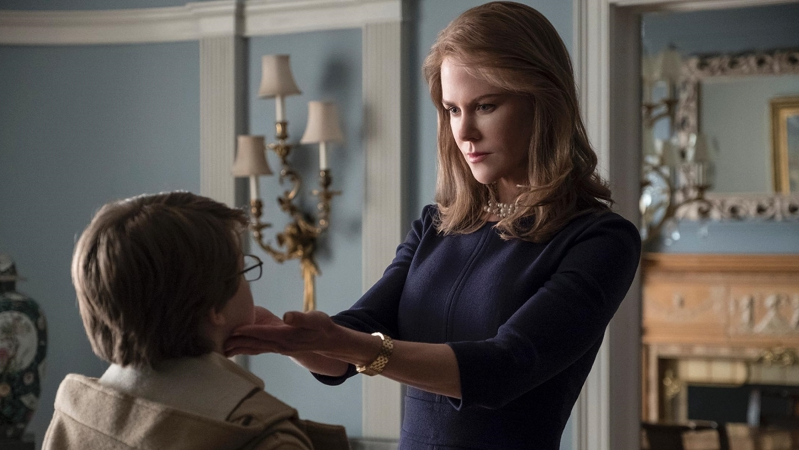
With his father absent, Theo moves in with a school friend, Andy Barbour (Ryan Foust), and his wealthy family where he grows close to the mother Samantha (Nicole Kidman). Meanwhile the ring leads him to the antiques business of James ‘Hobie’ Hobart (Jeffrey Wright), the partner of the man who died in the museum, and reunites him with the red-headed girl, Pippa (Aimee Laurence), who is convalescing with him. Theo will carry his unrequited love for Pippa throughout his life.


Out of the blue Theo’s father Larry (Luke Wilson) shows up with his girlfriend Xandra (Sarah Paulson) they uproot Theo to take him to live with them on the outskirts of Las Vegas, in a housing development that’s seems to be slowly disappearing into the Nevada desert. It is here that he meets a Ukrainian wild child called Boris (Finn Wolfhard), who calls him Potter (as in Harry) and who seems to have a bottle of vodka permanently glued to his hand. The two boys spend their days drinking alcohol and taking drugs.


When Theo's father gets drunk and dies in a car crash, he decides to return to New York but Boris won’t come with him. He is taken in by Hobie who teaches him the antiques trade and eventually Theo (now played by Ansel Elgort) becomes a partner in the business but gets in trouble for selling fake antiques. One such punter accuses him of stealing the Goldfinch and using it in a drugs deal. Which isn’t possible as Theo has the painting in his possession but hadn’t looked at it in years...

Then he runs into Boris (now Aneurin Barnard) again, now largely a gangster, and he reveals that he borrowed The Goldfinch from Theo when they were in Nevada and has since used it as collateral in some deals.


He also runs into the Barbours again (it’s a small world), bumping into Andy’s brother Platt (Luke Kleintank), who is now not quite the ******** he was back in the day and who breaks the sad news that Andy is no longer alive. Theo becomes engaged to the daughter Kitsey (Willa Fitzgerald) although Kitsey already has a long time boyfriend she intends to keep seeing but Theo is a better ‘face’ for the family. While Theo, of course, is still obsessed with Pippa (now Ashleigh Cummings), who has moved to London with her boyfriend to escape him or rather escape ‘their history’. FFS embrace it girl.


When Boris appears at Theo's engagement party (to the girl he doesn’t love who doesn’t love him and who isn’t Pippa anyway) with a plan to retrieve The Goldfinch they both jump on a plane to Amsterdam where Boris’s heavies attempt to steal the painting back. The plan goes awry and in the resulting melee, Theo kills one of the men that attacks them and an injured Boris disappears again leaving Theo alone in his hotel room contemplating suicide. 

Deep breath.


Yes it’s a complex film and one that seemed to trip over its own feet at almost every opportunity but I liked it. I liked the complexity of it all even if it didn’t make sense at times. It also seemed to runs out of steam resulting in an ending where Boris basically turns up to say ‘all sorted now’ leaving Theo embarking on a lengthy reflection that he only took the painting as a memento of his mother while the audience are muttering ‘what the hell happened there’.

Apparently the book is complex too and audiences these days are rarely trusted to work out things for themselves, so we should be grateful here for being given the chance in what is a good film but not an outstanding one.